|
|||
 <<<
Back <<<
Back |
|
|
|
| View Shopping Cart |
| Home |
| Guides Available |
| About the Author |
| FAQs |
| Testimonials |
| Articles |
| Contact Andrew |
| Terms & Conditions |
| Mailing List |
| Links |
  |
 |
 128
Bit Secure Shopping 128
Bit Secure Shopping |
Sign up for the Gibbs Guides newsletter now!
Beginner's Guide: Choosing Equipment
Part 3
By Andrew Gibbs
3 or 4 channels?
It’s fair to say that opinion is divided about whether a 3-channel
(rudder, elevator and throttle) or a 4 channel (3 channel controls plus
ailerons) model makes the best vehicle for training. Certainly a 3 channel
model is simpler and simplicity has a lot going for it especially in the
early stages of learning. Proponents of 4 channel models argue that it’s
best to start off with ailerons.
I feel that particularly for mature modelers, a 3 channel model is more than enough of a challenge to be going on with. In contrast, introducing ailerons straight away is perhaps a more suitable approach for young pilots. That said, my own experience was that I started RC flying as a teenager with a 3 channel model, and personally I think I might have found 4 channels to start with a bit much. The choice is yours!
Model
choice - ARTF, or build
from a kit or even from
a plan?
Another choice to be made
is choosing between an ARF/ARTF
(almost ready to fly) model,
and a traditional model
kit which will require building.
Also possible, but most
challenging is to build
a model from plans. Kit
and plan built models are
an excellent solution if
you like building and aren’t
in too much of a hurry to
start flying. It must also
be noted that the satisfaction
gained from building a model
yourself cannot be matched
by merely assembling an
ARTF model.
The big advantage of ARTF models is that they can be assembled relatively quickly, so they allow a rapid start to flying. Also, the emotional investment in such a model is much less, so should the worst happen and your model becomes badly damaged, at least you won’t have invested a lot of time and effort in building it. The choice is yours, and either approach can give you a great start to electric power flying.
Another possible approach is to buy both types – perhaps start with an ARF to allow you to start flying with the minimum of delay, and then find a kit to build in the meantime.
One final possibility is to buy a second hand model. This has the potential to offer a significant time and cost saving, especially if it’s offered with all the equipment necessary to go flying. However, purchasing a second hand model is fraught with potential problems. To avoid these it would be wise to recruit expert help to guide you.
Well, that’s covered model selection fairly thoroughly. Let’s now move on and discuss electric power systems:
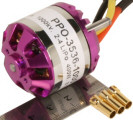
Brushless
motors and ESCs such
as this example from
www.4-max.co.uk
offer inexpensive
powerful and reliable
solution to electric
model power needs. |
Motors
and ESCs
These days, brushless motors
and suitable electronic
speed controllers (ESCs)
are relatively inexpensive,
and this combination would
be my first choice for a
beginner to electric power.
Compared to a brushed system,
brushless power systems
are more efficient, lighter,
require no maintenance and
frequently don’t cost
any more.
However, brushed motors may still be used successfully for certain models such as vintage types and powered gliders, so if you already own a brushed system there may be no need to replace it just yet.
Batteries
These days, the battery
choice for model aircraft
is usually considered to
boil down to a choice between
two types - Lithium Polymer
(LiPo) or Nickel Metal Hydride
(NiMH) types. LiPo batteries
are the usual choice, mostly
due to their light weight.
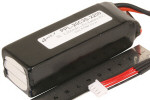
LiPo
batteries offer excellent
performance. They
need to be used with
care to avoid problems. |
However, for several reasons, most especially to do with safety, LiPo batteries must be handled with more care than other types. From this perspective, they are perhaps less suitable for beginners than any other battery type. However, many LiPo batteries are in use by beginners and problems are relatively uncommon, especially if the time is taken to learn how to use them properly. LiPo batteries require the use of a balancer. The Gibbs Guide to LiPo batteries is highly recommended for anyone using LiPo batteries (well, I would say that wouldn’t I?!).
As a beginner, if you want to go the LiPo route then its probably best to avoid the larger size of trainer both because the associated smaller battery will withstand crashes much more readily and because a smaller LiPo is inherently less risky than a large one. If you have experienced help to assist you in leaning to fly this issue is less important but it’s still worth bearing in mind.
If you aren’t comfortable with the idea of LiPo batteries, then NiMH types are a perfectly practical alternative. They weigh a bit more, but they are much more tolerant of mistakes and won’t catch fire. Their weight can actually be an advantage in some short nosed models (such as certain vintage types) where nose weight would otherwise be needed anyway. Also, they don’t require the expense and complication of a balancer and they will withstand the physical impact of crashes and the mistakes of rough handling much better.
A third choice is also available. These are known as A123 cells, and are a form of lithium cell. These are nearly as light as LiPo cells, extremely robust and don’t carry a significant fire risk. However, they are bulky, not widely available and are only available in one size.
Safety wise, probably the most important issue to take care of with any battery type is to avoid short circuits by (a) the selection of a suitable connector system and (b) taking care in use.
Battery
and motor combination
Brushless power systems
are usually combined with
LiPo batteries, although
this is not essential. Although
less usual, it’s perfectly
possible to use a brushless
motor with a NiMH battery,
or even a brushed motor
with a LiPo battery. However,
in every case the ESC used
must be suitable for the
battery chemistry in use.
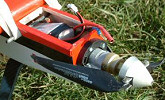
A
folding prop is another
way to reduce the
likelihood of prop
damage on landing |
Propellers
One factor of particular
importance with electric
power models is the propeller
- it’s vitally important
that a suitable example
is fitted to your model,
and unfortunately experience
with i.c. engines is often
of only limited help here.
The prop must be a good
match to the model and to
the rest of the power system,
with an appropriate diameter
and pitch. If the propeller
is too small in either dimension,
the model won’t have
enough power to sustain
flight, yet if it’s
too large the model may
well be overpowered, plus
the motor and ESC may quickly
become damaged.
When training, the prop may be expected to make frequent contact with the ground, for example in less than perfect landings. A rigid, easily broken prop is therefore a bad idea for beginners. A flexible alternative is probably a better choice. The possible reduced efficiency of a flexible prop is of no real significance with training models and may be ignored. Folding props are another solution to the issue. Do make sure that your props are balanced. Out of balance props can produce a surprising amount of vibration, which will waste power and perhaps cause damage to your model and its equipment.
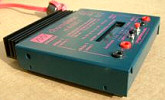
You’ll
need a charger for
replenishing your
batteries. |
Choosing
and using a fast charger
When starting out with electric
models, it may be tempting
to buy a charger that suits
your immediate needs only.
However, it may be worth
spending a little more on
a charger that will be able
to meet future needs as
well. There’s a wide
choice of compact microprocessor
controlled chargers that
can deal with a variety
of battery types at very
reasonable prices. Provided
that these come with easy
to understand instructions
they can make an excellent
choice. I recommend checking
the issue of instructions
carefully; it’s no
good having a capable charger
if its instructions make
it hard to use – this
problem is all too common.
RC gear
If you’re unsure of
your commitment to RC, or
you don’t relish the
thought of learning to programme
a computerized transmitter,
then get a basic, non-computerised
4 or 6 channel set. This
will be quite sufficient
for a wide variety of models.
Make sure the servos are
suitable for the model you
have in mind; for many trainers
‘standard’ servos
will be adequate. Smaller
models will however need
‘mini’ servos.