|
|||
 <<<
Back <<<
Back |
|
|
|
| View Shopping Cart |
| Home |
| Guides Available |
| About the Author |
| FAQs |
| Testimonials |
| Articles |
| Contact Andrew |
| Terms & Conditions |
| Mailing List |
| Links |
  |
 |
 128
Bit Secure Shopping 128
Bit Secure Shopping |
Get more high quality electric modeling information, absolutely free:
Sign up for the Gibbs Guides newsletter now!
Beginner’s Guide to Electric Flight
Part 1
By Andrew Gibbs
Introduction
For modelers considering a move into electric power models, the subject
of electric power can seem to be like a mysterious black art, with the
number of possibilities so enormous that it seems almost impossible to
know where to start. You may already have discovered that a familiarity
with internal combustion (i.c.) models, whether diesel, glow, or petrol
(gas) powered is of little help when investigating electric power, adding
to the sense of confusion.
Well, help is at hand! This article is aimed squarely at the beginner to electric flight. In it, I’ve also assumed that you are looking to learn to fly. If you can already fly RC models I hope you’ll still find much of the advice to be helpful. The main idea behind the article is to help you to make sound choices about what to buy, and also to give some useful pointers about getting started.
A bit of electric flight history
By the late 1990s, electric power was starting to become a serious alternative
to i.c. engines. A few large, practical models were being produced by
a small number of dedicated experts. These were very inspirational, and
interest in electric power grew, and along with it supplies of suitable
equipment. Since then electric power has enjoyed a rapid growth in popularity
and now accounts for a large proportion of sales.
Is electric power for you? –
the ‘pros and cons’ discussed
Electric power enjoys many advantages, as well as a few disadvantages.
There’s no reason yet to think that i.c. models will eventually
be killed off. To help you decide if electric power is for you, the following
discussion may help.
 |
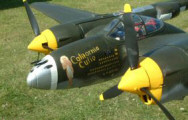 |
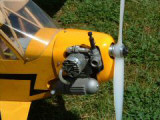
| IC or electric power – the choice is yours. | |
Reliability
Electric motors don’t need setting up for each flying session and
will start reliably – there’s no fiddling with needle valves
or those unexpected engine failures just after take off. Power failures
in flight are almost unheard of, apart from of course if batteries are
allowed to become exhausted. In flight starts are always possible, so
for powered gliders electric power is by far the best way to go, especially
with the availability of folding props. The reliability of electric power
means multi-engine electric models are an attractive and perfectly practical
prospect for more experienced electric flyers.
Noise and vibration
It goes without saying that electric models are of course very quiet,
and with no reciprocating parts, vibration is much less of an issue. Seasoned
electric modellers often find that the quietness of operation is an aspect
which increases the pleasure of a flying session, especially in an electric
only environment. They can even grow so used to the quiet that they begin
to find i.c. engine noise annoying!
Quiet operation also means that there are no problems with neighbours on noise grounds. As flying fields become ever harder to find and keep, this consideration alone is enough to consider electric power. Electric-only flying clubs have started springing up for this very reason. The near absence of in flight vibration also means that RC gear will tend to last longer, although it should still be protected against the shocks of take off and landing.
Cleanliness
One of the nicest benefits of electric models is that there’s no
oily mess or smell to contend with. Your transmitter and everything else
you handle while flying will stay clean. You’ll arrive home with
your car’s steering wheel clean and without your clothes and skin
smelling of fuel and oil. There’s no danger of your flight box leaking
oily fuel either. Electric models are much more household-friendly so
expect much less resistance from other family members!
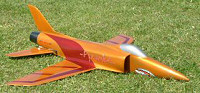
Performance is not of any
great concern when learning to fly. However it’s nice to know
that as you progress, some very fast models are waiting for you
if that’s your thing. This one’s good for well over
100 mph. |
Clean models are also easier and more pleasant to maintain and repair. One advantage of this is that they have the potential to last longer. Once you get used to the cleanliness of electric power, it’s hard to go back to i.c. models. I do still have a few, but only rarely now do I take them out for a flying session because I prefer coming home spotlessly clean!
Performance
Electric power performance is now limited more or less only by your budget.
Electric powered models are no longer playing second fiddle in performance
terms to i.c. engine models – some are very fast indeed, especially
some of the high performance electric ducted fan (EDF) types.

A propeller tip caused this
deep cut. I have much more gory pictures than this one of injuries
inflicted by models on their owners, but I didn’t use them
because I want you to able to keep reading! Missing digit or exposed
bone anyone? |
Health and safety matters
Electric powered models may appear safer than i.c. power, especially as
they are so quiet and don’t need toxic fuel. An electric motor can
potentially start any time the battery is connected to the model. This
possibility should always be taken into consideration when handling models
– keep your body parts away from the prop arc at all times, even
when the prop is stationary. It’s not unknown for motors to burst
into life due to an inadvertent throttle command, interference, or even
a speed controller malfunction. A sharp prop blade rotating at 10,000rpm
or more clearly has great potential to inflict serious injury.
Furthermore, unlike an i.c. engine, the turning force (torque) of an electrically powered prop blade will increase if it’s slowed by contact with a body part. Remember that unlike an i.c. engine, an electric motor will actually continue to try and rotate until power is removed from it, making it potentially more dangerous than i.c. power.
Batteries must also be treated with care. Short circuits can produce burns and fires and must be carefully guarded against. Experience shows that we must proceed with caution otherwise we or others may become injured.
Scale models
Scale models in particular benefit from electric power. Unlike i.c. engines,
electric motors can always be completely hidden within a cowl, plus there’s
no bulky silencer to try and hide. Another plus is that scale detail won’t
be affected by oil and vibration every time you fly.
Charging batteries
Batteries take time to recharge, so ‘refueling’
is not as quick as with i.c. models. This problem is very
easily solved by simply having more than one battery and
perhaps two or more chargers.
The necessary power source for recharging is another issue. Many modellers bring a lead acid battery to the flying field to recharge flight packs from. This is an excellent solution, although the sheer weight of a standard car or leisure battery (of 12V and perhaps 60Ah or more) can be really problematic especially for the mature modeller.
However, for smaller models a much smaller and hence much lighter lead acid battery will suffice (e.g. 12 V, 15 Ah capacity), and this will solve the weight problem nicely. If more battery capacity is required then two or more smaller, lighter batteries can be used together, joined in parallel. A simple trolley can be used to carry batteries between your car and your flying site.
Some modellers get around the charger battery issue completely by bringing enough charged flight packs for the intended flying, but this solution can become expensive unless you are satisfied with only a few flights. Others simply use their car’s own battery for a source of power, and this solution completely eliminates any need to carry lead acid batteries. This solution can work well provided it’s not used so much that the car won’t start afterwards. Another solution is to bring a number of charged packs and combining this with using your car’s battery.
Operating atmosphere
Some modellers really like the whole business of operating a small engine,
with the attendant noise, smoke and the feeling that when it’s running
the engine is almost a living, fire breathing creature. There’s
no denying that for many these factors combine to create an ‘operating
atmosphere’ which is missing from electric models. Also, there’s
something attractive about the craftsmanship inherent in small engines.
Finally, model i.c. engines may appeal for nostalgic reasons. However,
electric power is not an either/or option, and many modellers (including
me!) have i.c. as well as electric power models.
Sound
Electric motors can’t really compete in any of these areas, except
perhaps in the area of sound. Recently on-board sound systems have been
developed by enthusiasts to provide a highly realistic scale engine sound.
However, if you are just starting out in electric flight, sound is probably
going to be the least of your worries!
 |
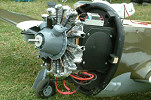 |
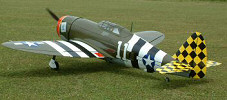
It's literally a spine tingling experience to witness this apparently Pratt & Whitney R-2800 twin-row radial powered P47 Thunderbolt start up, falter momentarily and then settle into an even, deep radial rumble. It’s also wonderful to hear the big radial rise to a crescendo on take off, sounding very much like the 2,300 hp full size machine straining skyward in pursuit of enemy fighters. The weight of these sound systems means they are presently only suitable for larger models such as this large warbird built by expert modeller Pete Nicholson, but such is the pace of development that we may well see sound systems being made available for smaller models in coming years. Let’s hope so because the experience of an authentic sounding scale model is unforgettable! |
|
Cost and model size
Few of us have unlimited budgets for our modelling so value for money
is always an important issue. For any given model, an electric power system
will generally cost more than for an equivalent i.c. engine. With small
models, the additional cost is small, however as models become larger
the extra cost of electric power starts to become very significant. As
we move towards high voltage (and hence high power) systems costs can
escalate rapidly. A balancer will be necessary if using LiPo batteries.
For some models such as indoor types electric power may be the only option and in any case at this end of the size range costs are usually very low.
On the plus side there’s no expensive fuel to buy, and the cost of the electricity is so low that it can be ignored. Electric modellers don’t need to buy a throttle servo, fuel tank, fuel filters etc either. Plus, there’s no need to find any of the equipment necessary to equip an i.c. flight box like a fuel pump, electric starter, battery, power panel, glow stick etc.
The upshot of all this is that over the course of a year or two, electric models will probably end up costing approximately the same as an equivalent i.c. set up. The actual costs will of course depend on your particular choices. If money is really tight then smaller models are definitely the way forward.